CASE STUDY | ROBOTIC AUTOMATION
Client: Kane Robotics
Industry: Collaborative robotics for sanding, grinding, and finishing
Services: Mobile 3D Laser Scanning, Mesh Segmentation, Reverse Engineering, CAD File Creation
Timeline: 7 days from first email to on-site scan, 10 days from scan to cleaned and aligned data
The Client
Kane Robotics builds the GRIT line of collaborative robots for sanding, grinding, and finishing, aimed at high-mix, low-volume manufacturers. Their premise is stated in their own tagline: work with robots, not like robots. The cobot takes the repetitive, physically punishing surface work, and the skilled operator stays on the job instead of on the grinder.
That premise depends on one thing. The robot has to know the shape of the part.

The Problem: A Robot Cannot Follow A Surface It Has Never Measured
Kane needed to program a cobot to follow the contours of a helicopter main rotor hub assembly. Path programming on a complex, compound-curved component is not something you eyeball or approximate. The toolpath has to track the real surface, at the real angle, across the real part.
There was no CAD to work from. The component was legacy hardware, and Kane’s engineering team had no model of it to align to, generate paths from, or check against. As their CEO John Spruce put it in the first conversation, the intent was to use scan data to develop path programs for the robots to follow the surface contour.
There was also an access problem. The hub was installed in a remote hangar. It could not be crated, shipped, or brought to a metrology lab in California. Whatever measurement happened had to happen there.
And the window was short. The request came in on a Friday morning asking about the following Friday.

Why Kane Robotics Called Tangent Solutions
Kane found us through a client we had already worked with, who had seen our on-site output firsthand. Their CEO’s read on us before we ever spoke was simple: it is obvious you do on-site work.
That is the fit. Our scanning is fully mobile, so the equipment travels to the asset rather than the other way around. We handle post-processing and reverse engineering in house, so the point cloud never gets handed off to a third party to become CAD. One team owns the result from the hangar floor to the delivered file.
We quoted the same day the request came in.
The Approach
Move At The Speed Of The Opportunity. First email Friday morning. Quote out that weekend, signed and deposited Wednesday, engineer on site the following Friday. When the schedule tightened again, we moved to an earlier flight so scanning could start at 9:00 AM instead of mid-afternoon, which put the full working day on the part rather than half of it.
Scan Where The Part Lives. The assembly was captured in place, in the hangar, with no disassembly, no facility shutdown, and no shipping. The site was left exactly as we found it.
Metrology-Grade Capture. Scanning was performed with the Creaform HandySCAN BLACK Elite. On a bolted rotor assembly with splines, threaded collars, and stacked conical surfaces, that means the geometry is measured, not interpolated.
Post-Processing: Taking A Bolted Assembly Apart Digitally
Back in our lab, the raw scans were cleaned, merged, and aligned. Then came the step that made this project useful rather than merely accurate.
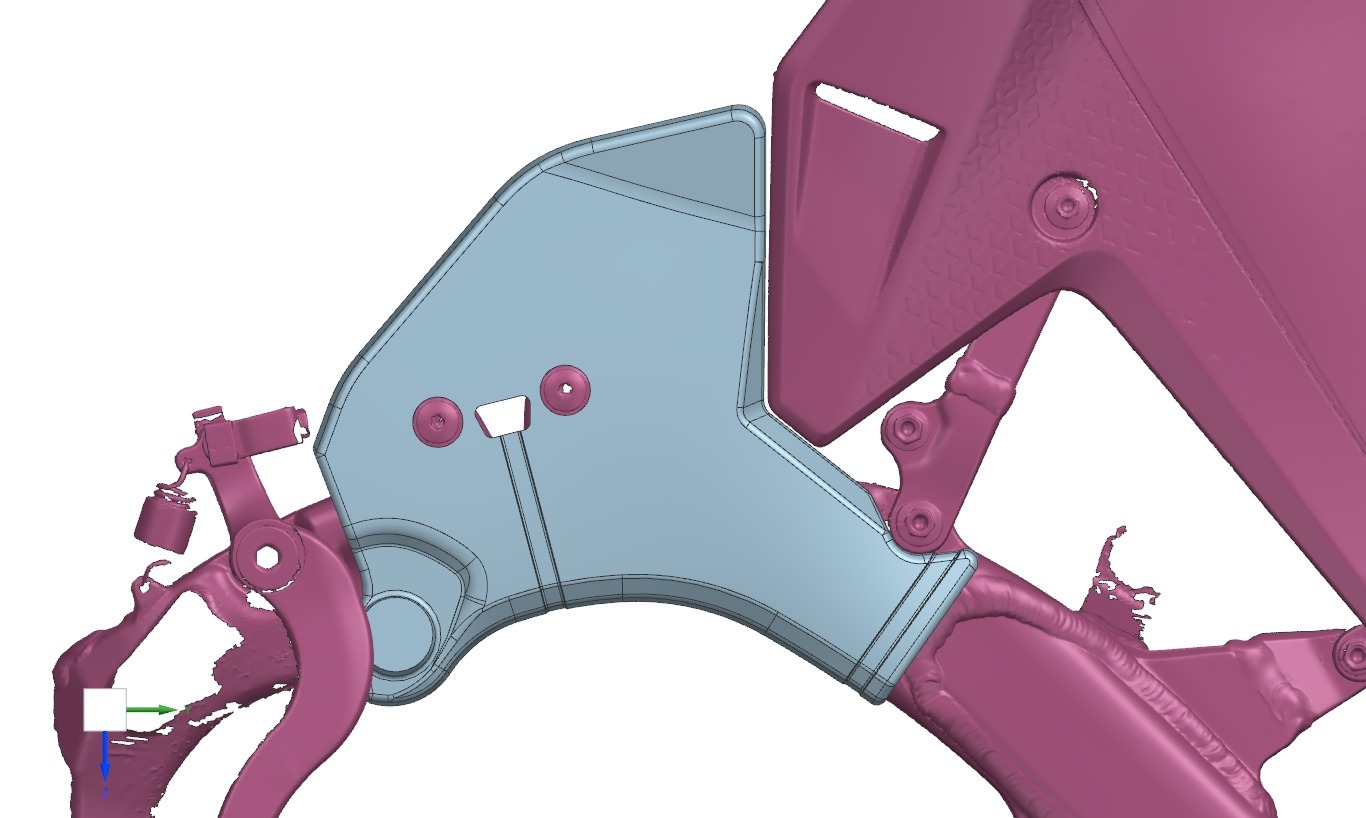
Rather than deliver one undifferentiated mesh of an assembly, we segmented the scan into eleven individually named components: the main gear box mast, the main hub and its arm, the retaining element, the top conical ring, the lower cone, the top cap, the ring nut, the small nut, the washer, and the bolt. Each one arrived as its own usable body.
That segmentation handed Kane’s engineers a decision they could not otherwise have made. Instead of accepting or rejecting a single monolithic file, they reviewed the component list with their lead mechanical engineer told us exactly which pieces they wanted carried forward into solid CAD.
We shared the segmented list and a shaded preview of the mast in its assembly context mid-project, so the team could reason about the data before final files existed.
Scoping The Model To The Job, Not To The Part
Kane’s answer on the mast was as valuable as the scan itself. They needed the outer surfaces the tool would actually touch. They did not need the internal detail inside the tube of the mast, and they did not need the external spline.
So we did not model them.
This is the difference between reverse engineering a part and reverse engineering a task. A full as-built model of every internal feature would have cost Kane more, taken longer, and delivered geometry no toolpath was ever going to reference. We modeled the scope that the robot needed and left the rest as measured mesh, available if they ever wanted it.
What We Delivered
- Cleaned, aligned as-built scan data of the complete rotor hub assembly.
- 11 individually segmented and named component meshes.
- STEP files for the components Kane selected.
- Reverse-engineered CAD of the main gear box mast, scoped to the external surfaces required for robot path generation.
- Files delivered by secure download link.
The Result
Kane Robotics went from having no geometry at all for a legacy assembly to holding measured, segmented, path-ready CAD, without the part ever leaving the hangar it was installed in.
The engagement was straightforward and positive on both sides. Kane got what they needed to move forward with their work, we got a clear scope and good technical partners on the other end of the email, and the conversation has continued past this project toward the next one.
Do You Have A Part Your Robot Cannot See?
Automation stalls when the geometry does not exist. If the part is legacy, installed, oversized, or in service somewhere you cannot ship it from, it can still be measured. Tangent Solutions brings metrology-grade 3D scanning to your site and delivers finished, path-ready CAD from our own lab in Costa Mesa, California.
Reverse engineering. First Article Inspection. Surface modeling. Product development.
Contact Tangent Solutions at (949) 345-0611 or contact@usetangent.com to scope your project.